
Cat Loves Wheelchair
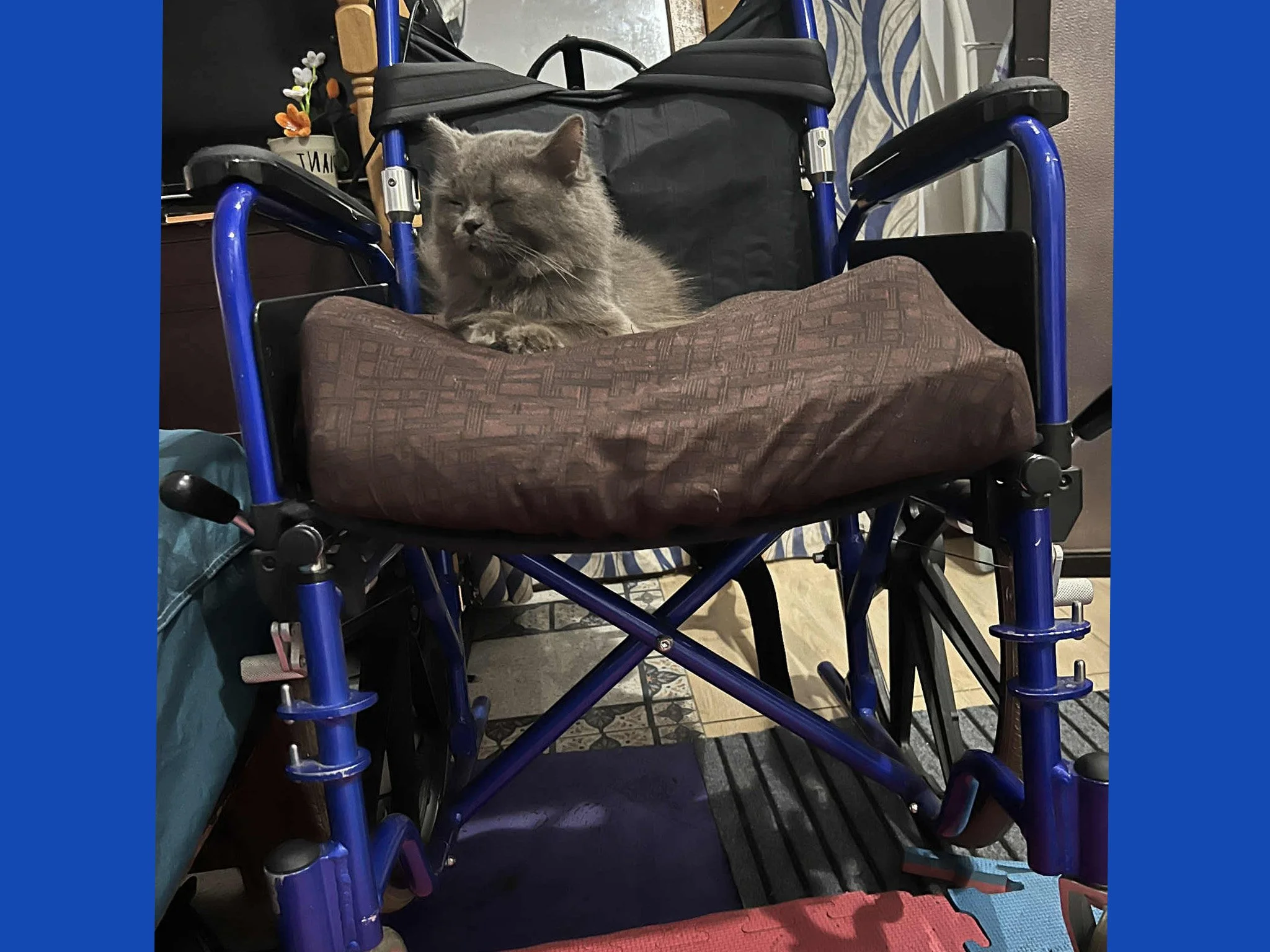
I’ve always had a strong dislike for being in a wheelchair, as it made me feel restricted and dependent. However, my perspective changed when I saw Israel, who seems to comfortably embrace it and finds solace in his situation. Meanwhile, my in-laws have taken in a Persian cat from a rescue organization, and he has quickly become a beloved part of our family. In fact, he's turned into quite the little charm, bringing joy to our lives and even turning out to be quite the "baby maker," as we've jokingly started calling him, since he's already sired a few adorable kittens.
Crooked Neck
Imagine a world where compassion reigns, where no living being is abandoned because of their differences. In the past, individuals born with disabilities were often cast aside, and tragically, this fate has also befallen many animals in need. Here at the Hope Ebony Animal Society, we strive to change that narrative.
Meet Michelle, a resilient and stunning cat who captured our hearts the moment she arrived. Born with a unique crooked neck, her charm and spirit shine brightly despite the challenges she faces. Michelle is a testament to the beauty of diversity and the strength of animals who, like all of us, deserve love and care.
Join us in our mission to advocate for animal rights and make a difference. Visit heas-cp.com to learn how you can get involved and support these deserving creatures!
Running Over Gigi Saved Her Life
My cats have a unique fascination with my wheelchair, often turning it into their personal playground. Israel, my regal Persian cat, has claimed the seat as his favorite spot to nap whenever I'm not using it. Deep, my spirited feline with cerebral palsy, has a quirky habit of using the wheelchair wheels as his very own scratch post, delighting in the satisfying sensation as he stretches and sharpens his claws.
Then there's Egypt, affectionately known as Gigi, who is the sole survivor from Kassandra’s unfortunate litters. Kassandra, my resilient mother cat, struggled through three litters where all but Gigi perished. It was Mulan, another cherished cat in our household, who stepped in to nurse Gigi, ensuring she received the vital care she needed to thrive. Gigi has blossomed into a stunning Persian kitten, radiating beauty and a playful spirit, often found lounging beneath my wheelchair, basking in the warmth and security it provides.
One fateful afternoon, while I was moving my wheelchair, I accidentally ran over Gigi, who had curled up in her usual cozy spot underneath. The moment I realized what had happened, panic surged through me. My wife, Jennifer, sprang into action, scooping Gigi up and rushing her to the Laguna clinic, our trusted veterinary facility.
Our hearts raced as we waited for updates, initially fearing the worst—the possibility of severe injuries from the accident weighed heavily on our minds. However, after a comprehensive examination by the veterinarians, our concern shifted dramatically when we learned the truth. Gigi was diagnosed with a critical skin disease that had, unbeknownst to us, been festering beneath the surface. The situation was dire enough that she required an immediate blood transfusion to stabilize her condition.
Looking back, it became evident that while the incident with my wheelchair was deeply frightening, it inadvertently led to the discovery of Gigi's serious health issues. Without the swift intervention of the Laguna clinic, her life may have been at serious risk.
Now, Gigi is back home, reuniting with her companions, Israel and Deep. She is on the mend, her spirit unbroken, and as we care for her through this recovery, I am profoundly thankful that an unfortunate accident turned into a life-saving moment for our precious little girl.
Why Cats Are Cool?
Good day! I am Yvonne Pinnock, The Cat Whisperer. You can Google my father’s book, YVONNE, THE CAT WHISPERER.
Now, let me tell you some cool cat facts:
Cool fact 1: Cats can jump up to six times their length.
Cool fact 2: Cats have 230 bones, while humans only have 206.
Cool fact 3: Cats have an extra organ that allows them to taste scents in the air, so your cat occasionally stares at you with her mouth open.
Cool fact 4: Cats have nearly twice the number of neurons in their cerebral cortex as dogs.
Cool fact 5: Cats walk like camels and giraffes
Let me tell you, my cool cat loves.
Cool cat love 1: I love cats because they are friendly.
Cool cat love 2: I love cats because they are sweet.
Cool cat love 3: I love cats because they are kind.
Cool cat people health facts: Cats are good for the elderly because they can help lower blood pressure, reduce cholesterol, relieve stress, and improve mental health. Seniors living with cats feel mentally, emotionally, and physically better.
Cool cat Quincy is my favorite cat . He is only two months old and makes me happy.
I conclude that cats are the most incredible pets at home. Also, at lulu.com, buy Yvonne, the cat whisperer, to support my mother’s cat Hope Ebony Animal Foundation.
What did I tell you? Cats are freaking cool!
General Trainer Qualifications
Before starting to train your Emotional Support/Service Animal Cat, you must meet these trainer qualifications:
1. It takes a year to complete it from the time you start the training.
2. Have or acquire knowledge about your Emotional Support/Service Animal Cat.
3. Have the proper tools to do the training.
4. Knowing how to use treats. Treats reward good behavior. Use small treats; you do not want your Emotional Support/Service Animal Cat to have a full meal when training. Later after the good behavior is recognized, you will be able to stop the treats so that you do not have to use them anymore. Treats should be just that, treats. Never use your Emotional Support/Service Animal Cat’s dinner food for treats. Use good healthy treats in small portions. Do not give large amounts; this is a treat, not dinner.
Assisted Therapy
The medical, rehabilitative, and therapeutic name for accommodating cats is Animal-Assisted Therapy, a type of therapy involving animals as a form of treatment.
Animal-Assisted Therapy is a type of therapy that incorporates animals in treating people, especially elderly people, in nursing homes or long-term care (LTC) facilities.
Using animals as a treatment option aims to improve the person’s social, emotional, and cognitive functioning and reduce passivity.
Say, “No”, Not Punish
NEVER harm your Emotional Support/Service Animal Cat, as it will cause it to fear you; in return, it will not come near you.
Use a firm “NO” or loud noise to inform your Emotional Support/Service Animal Cat that you disapprove of its behavior.
The Clicker Training Method
A clicker can be used and is efficient in helping train your Emotional Support/Service Animal Cat.
We must remember that all cats have personalities, so there could be a chance that your Emotional Support/Service Animal Cat will not act as quickly or to the clicker.
Clicker training is a reinforcement or reward method of training. Cats associate the clicker with good behavior.
They will use for a long time. Clicker training is associated with the classical condition, they associate the sound with food, and operant conditioning, the cat performs movement to receive food.
Bone Structure
Your Emotional Support/Service Animal Cat can jump and land on its feet because this behavior is instinctive for your Emotional Support/Service Animal Cat.
When a kitten is first born, the cushion in its paws is not developed.
Developing the cushion in your Emotional Support/Service Animal Cat’s paw for jumping and landing takes about seven weeks.
Your Emotional Support/Service Animal Cat’s bone structure is more unique than other animals, as the bones are flexible.
Cats have no collarbone, allowing them to twist and bend their bones.
Cats can jump from short distances without sustaining any injuries.